Bible study
He Wore It First
The armor of God in Isaiah 59 and Ephesians 6
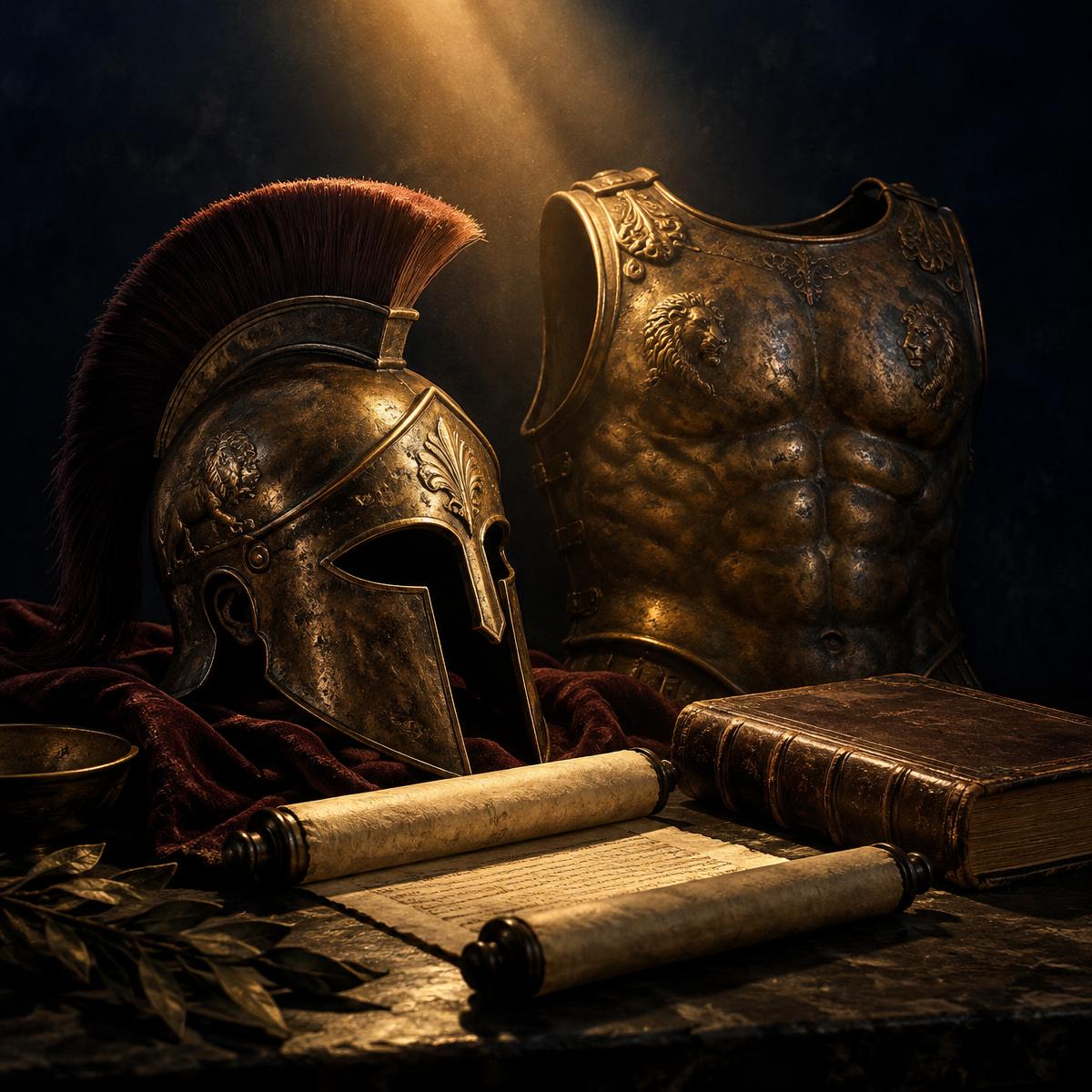
Audio and lyric video coming soon
The study is ready to use now.
The core discovery
The armor was His before it was ours
In Isaiah 59, God looks at His people and sees that justice has been pushed back, righteousness stands far off, and truth has stumbled in the public square. Isaiah 59 addresses the community's injustice and covenant unfaithfulness; verses 20-21 continue with a Redeemer and covenant promise. No one steps in to help. So the LORD acts Himself: His own arm brings salvation, and He puts on righteousness like a breastplate and a helmet of salvation on His head (Isaiah 59:16-17).
Centuries later, Paul writes to the church in Ephesus: be strong in the Lord and in the strength of His might, and put on the whole armor of God (Ephesians 6:10-11). The breastplate of righteousness and the helmet of salvation reappear. These strong verbal echoes invite Christians to read Paul's imagery in light of Isaiah. Ephesians does not formally quote Isaiah here. In Isaiah, the LORD wears the breastplate and helmet as He acts to rescue.
Side by side
Compare the passages
These are paraphrases, not a Bible translation. Read the full passages in a trusted translation using the links.
Old Testament · Isaiah 59:14-17
The LORD sees, and steps in
Justice is driven back and righteousness keeps its distance; truth has fallen in the street, and honesty can find no way in.
Truth is missing, and whoever turns from evil is plundered. The LORD saw it, and it displeased Him that there was no justice.
He saw there was no one, and was astonished that no one would intervene. So His own arm brought salvation, and His righteousness held Him up.
He put on righteousness as a breastplate and a helmet of salvation on His head; He wrapped Himself in garments of vengeance and zeal as a cloak.
New Testament · Ephesians 6:10-18
The church is clothed, and stands
Finally, be strong in the Lord and in His mighty power. Put on God's full armor so you can stand against the devil's schemes.
Our struggle is not against flesh and blood, but against rulers, authorities, and spiritual forces of evil in the heavenly realms.
So take up God's full armor, and having done everything, stand: with truth fastened like a belt, righteousness as a breastplate, and feet ready with the gospel of peace.
Take up the shield of faith, the helmet of salvation, and the sword of the Spirit, which is the word of God: praying at all times in the Spirit, staying alert for all the saints.
Piece by piece
Breastplate of righteousness
Eph 6:14 ← Isaiah 59:17
Thematic echoStrong shared wording. Paul does not introduce it as a quotation, but the imagery clearly matches Isaiah.
Read Isaiah 59:17(opens in a new tab)Helmet of salvation
Eph 6:17 ← Isaiah 59:17
Thematic echoThe same pairing of helmet and salvation. Paul also uses this image in 1 Thessalonians 5:8.
Read Isaiah 59:17(opens in a new tab)Belt of truth
Eph 6:14 ← Isaiah 11:5
Thematic echoThe coming Branch of Jesse wears righteousness and faithfulness as a belt: a related but not identical image.
Read Isaiah 11:5(opens in a new tab)Feet ready with the gospel of peace
Eph 6:15 ← Isaiah 52:7
Thematic echoIsaiah celebrates the feet of the one who brings good news of peace. Paul quotes Isaiah 52:7 directly in Romans 10:15.
Read Isaiah 52:7(opens in a new tab)Sword of the Spirit
Eph 6:17 ← Isaiah 49:2
Thematic echoThe Servant's mouth is made like a sharp sword. A broader, metaphorical echo rather than a direct borrowing.
Read Isaiah 49:2(opens in a new tab)Shield of faith
Eph 6:16
Distinct in this comparisonNo direct parallel in Isaiah 59 or the other Isaiah passages compared here. Ephesians includes a shield of faith against flaming arrows.
Teaching
Historical & literary background
Isaiah 59 belongs to the final section of the book (chapters 56-66), addressed to a community whose sins had separated them from God (59:1-2). The chapter moves from accusation, to confession (59:9-15a), to the LORD's own intervention as a divine warrior (59:15b-19), ending with the promise of a Redeemer coming to Zion and God's Spirit and words remaining on His people (59:20-21).
Ephesians is a letter traditionally attributed to the apostle Paul, written while he was imprisoned (Ephesians 6:20 calls him an ambassador in chains). The armor passage is the letter's closing exhortation, following teaching on what God has done in Christ (chapters 1-3) and how the church is to live (chapters 4-6).
Theological meaning
In Isaiah 59:17 the LORD is pictured as a divine warrior, not Israel putting on this armor. He intervenes where no human intercessor acts. Righteousness and salvation are not accessories: they describe His character and His action.
Paul's command to put on 'the armor of God' should be read in that light. Believers stand in a strength that is not their own: 'be strong in the Lord and in the strength of His might' (6:10). In Christian reading, this armor expresses God's gifts and believers' lived fidelity: truth, righteousness, peace, faith, salvation and God's word. Righteousness here should not be reduced without argument to either a credited status or moral performance alone. Prayer sustains the whole exhortation, rather than being named as another piece.
God wearing armor vs. believers receiving His armor
In Isaiah, God wears the armor to accomplish salvation. In Ephesians, the church wears it to stand firm in a salvation already accomplished. The direction matters: we do not put on righteousness to earn rescue; we depend on God's saving action while living faithfully in truth and righteousness. The precise meaning of the breastplate should not be asserted as only one kind of righteousness.
Notice too that the posture in Ephesians is mostly to 'stand' (6:11, 13, 14). Read alongside the letter's account of Christ's exaltation (Ephesians 1:20-23), the repeated command to stand points to dependence on God rather than self-reliance.
Not against flesh and blood
Ephesians 6:12 reframes conflict. Our struggle is not against flesh and blood. The coworker, the family member, the online opponent is not the true enemy. That changes how a Christian argues, forgives, and prays.
Truth, righteousness, peace and prayer are not weapons for defeating people but ways of standing faithfully while loving them.
Direct wording vs. broader parallels
The breastplate of righteousness and helmet of salvation are the strongest verbal links to Isaiah 59:17. The belt (Isaiah 11:5), feet of the messenger (Isaiah 52:7) and sword-like mouth (Isaiah 49:2) are broader echoes within Isaiah's imagery. The shield of faith has no direct parallel in the Isaiah passages compared here. None of these is presented in Ephesians as a formal quotation, so this study calls them echoes rather than citations.
Timeline
Centuries apart, one story
Dates are approximate. When an event happened and when a text was written are not always the same thing.
8th century BC
Isaiah's prophetic ministry
Isaiah son of Amoz prophesied in Judah during the reigns of Uzziah, Jotham, Ahaz and Hezekiah (Isaiah 1:1).
Dating debated
Composition of Isaiah 56-66
Scholars hold different views on when these chapters were written and compiled. Conservative scholars generally attribute the book to Isaiah; others assign later dates.
Early 1st century AD
Life, death & resurrection of Jesus
Christians read Isaiah 59:20's Redeemer promise in light of Jesus; Isaiah speaks of a Redeemer coming to Zion and covenant faithfulness.
Mid-1st century AD
Paul writes Ephesians
Written during an imprisonment, commonly dated to around the early 60s AD. Some scholars propose other dates or authorship.
Reflect
Questions for reflection
- 1
Why does God intervene in Isaiah 59?
Read Isaiah 59:14-16. What does God see? What does it mean that 'there was no one'? What does that say about our ability to save ourselves, and about God's heart?
- 2
What changes in Ephesians when the people of God are told to wear the armor?
Compare who wears the armor in each passage. How does knowing God wore it first change the way you hear the command to 'put on' and 'stand'?
- 3
How can truth, righteousness, peace and prayer shape how you respond to everyday conflict?
Think of a current tension: at home, at work, online. If your struggle is 'not against flesh and blood,' what would standing in truth, righteousness and peace look like there this week?
Together
Small group discussion
- Read Isaiah 59:1-21 aloud. Where do you see accusation, confession, and rescue?
- Read Ephesians 6:10-20 aloud. Which piece of armor feels most needed in your life right now, and why?
- Why do you think Paul ends the armor passage with prayer rather than another piece of armor?
- How does Ephesians 1-3 (what God has done) prepare us for 6:10-20 (how we stand)?
- Pray for one another by name, as Paul asks in Ephesians 6:18-19.
Live it
Practical application
- Begin each day this week by reading Ephesians 6:10-18 and naming each piece as a gift you receive from God.
- When conflict rises, pause and pray before responding: remember the person in front of you is not your enemy.
- Memorize Isaiah 59:16-17 or Ephesians 6:10-11.
- Pray for a fellow believer by name each day, as Paul asks for prayer in 6:19.
Key takeaway
The armor of God is God's armor. In Isaiah, the LORD put on righteousness and salvation to rescue a people who could not rescue themselves. Christians read Ephesians' breastplate and helmet alongside that image. Believers are called to stand in the Lord's strength with His gifts and lived fidelity in truth, righteousness, peace, faith, salvation, His word and prayer. The other Isaiah comparisons are looser parallels, and the shield is distinct here.
The song
Lyrics
Intro - Male spoken, quiet Rhodes
Before Paul wrote about armor, Isaiah had already seen it. And the One wearing it... Was God.
Verse 1 - Male, calm rhythmic storytelling
Isaiah fifty-nine, hear the sorrow of the streets, Truth had stumbled; justice couldn't find its feet. They were looking for the light, but darkness filled the air, And when the Lord sought one to stand, nobody was there. So His own arm brought salvation where no one could intervene, He clothed Himself in righteousness to answer what He'd seen. A breastplate on His chest, salvation on His head, Long before Paul wrote his letter, those very words were said. This armor isn't human strength or something we deserve, Before God called His people, He Himself had gone to work.
Chorus - Female soulful lead, beat opens
He wore it first, He wore it first, When truth lay fallen in the dirt. Righteousness across His chest, Salvation on His head. Now He calls His own to stand In the strength of His mighty hand. From the prophet to the church, He wore it first, He wore it first.
Verse 2 - Male, measured and revealing
Now Isaiah eleven, see the Branch from Jesse's line, Righteousness and faithfulness around His waist entwined. In fifty-two, the messenger brings news across the hills: "Your God reigns!" A word of peace that echoes even still. In forty-nine, the servant's mouth is like a sharpened sword, A picture of the power carried by the spoken word. In fifty-nine, a Redeemer's promised, coming to restore, And through the saving work of Jesus, we can see much more. Different chapters, one unfolding story, listen as it grows: The prophets lay the groundwork for the armor Paul will show.
Chorus - Female lead, warm harmonies
He wore it first, He wore it first, When truth lay fallen in the dirt. Righteousness across His chest, Salvation on His head. Now He calls His own to stand In the strength of His mighty hand. From the prophet to the church, He wore it first, He wore it first.
Verse 3 - Male, intimate conviction
Now Ephesians chapter six: be strong in the Lord, Not in what your hands can make or what your pride affords. Our struggle isn't flesh and blood, don't turn a soul into a foe, It's a deeper kind of darkness that God's people need to know. Truth around your waist, let righteousness protect your heart, Carry peace upon your feet wherever you depart. Faith can quench the fiery darts; salvation guards your head, Take the Spirit's sword, God's word, and pray through every step. You cannot fight for righteousness while choosing hate instead, Stand in what the Lord provides, and stand when all is said.
Bridge - Female spoken-sung, music strips down
The world had lost its truth and peace. God stepped in when none could stand. Now He calls us to live those very things, Not by our power, but by His hand.
Final Chorus - Female lead, layered gospel warmth
He wore it first, He wore it first, When truth lay fallen in the dirt. Righteousness across His chest, Salvation on His head. Now He calls His own to stand In the strength of His mighty hand. From the prophet to the church, He wore it first, He wore it first.
Outro - Male spoken, soft
Read the pages together. See the story unfold.
Keep reading
Full Bible passages
Next
Explore more connections
More studies are being written. Browse the songs and connections library.